Vitamins, minerals, and hair loss: Is there a connection?
Table Of Content

Here we review the structure and function of the specialized primary cilia of hair cells, termed kinocilia, found in the mammalian auditory system. We also discuss areas that might prove amenable for therapeutic management of auditory ciliopathies. It is important to note that OHC are not the only targets of MOC fibers.
Supplementary information S1Please note that this is a very large file and will take time to download. (EXE 20007 kb)
As hair cells become activated, secondary afferent neurons with cell bodies in the spiral ganglion pick up neurotransmitters from inner hair cells and send signals along the auditory nerve to the brain. Auditory information is shuttled to the inferior colliculus in the brainstem, the medial geniculate nucleus of the thalamus, and finally to the auditory cortex in the temporal lobe of the brain for processing. Like the visual system, there is also evidence suggesting that information about auditory recognition and localization is processed in parallel streams (Rauschecker & Tian, 2000; Renier et al., 2009). Inside the inner ear, which is located on the internal side of the eardrum, are more tiny pieces of hearing equipment. The cochlea is the major component, and part of the cochlea is the Organ of Conti.
Xanthohumol, a prenylated flavonoid from hops (Humulus lupulus L.) exerts multidirectional pro-healing properties ... - ScienceDirect.com
Xanthohumol, a prenylated flavonoid from hops (Humulus lupulus L.) exerts multidirectional pro-healing properties ....
Posted: Wed, 10 Jan 2024 22:39:24 GMT [source]
Two Kinds of Hair Cells in the Cochlea
Researchers gained insights into how cells in the auditory system become organized to hear different frequencies. The findings could lead to new approaches for certain kinds of hearing loss. The effect of this system is to nonlinearly amplify quiet sounds more than large ones so that a wide range of sound pressures can be reduced to a much smaller range of hair displacements.[17] This property of amplification is called the cochlear amplifier. You should avoid a scalp detox if you have sensitive skin or an inflamed scalp.
In contrast to the inhibitory effects of efferent modulation in the auditory system, efferent modulation of vestibular hair cells has both excitatory and inhibitory effects (Jordan et al. 2013). Calyx-bearing afferents (similar to type I cells) are excited by efferent fibers, which synapse postsynpatically onto the afferent nerve ending (Holt et al. 2015). Bouton afferents (similar to type II cells) receive both presynaptic efferent innervation (directly onto the hair cell) and postsynaptic innervation onto the primary afferent. Efferent stimulation of bouton afferent cells is initially inhibitory, followed by an extended postinhibitory excitation (Holt et al. 2006). As in the cochlea, acetylcholine is the neurotransmitter and fast synaptic effects are mediated by alpha-9 containing ACh receptors, with inhibitory effects mediated by SK Ca2+-activated K+ channels (Parks et al. 2017). In addition, muscarinic acetylcholine receptors mediate a slower excitation in calyx-bearing afferents, probably by inhibition of an M-current (Holt et al. 2017).
In rat cochlea, inner hair cells toward to apex with an expected best frequency of 4 kHz had stereocilia that were twice as long as those in hair cells with an expected best frequency of 30 kHz (Furness et al. 2008). These differences are likely to enhance frequency sensitivity, as the stiffness of stereocilia is inversely proportional to the square of their length in frog sacculus and turtle cochlear hair cells (Crawford and Fettiplace 1985; Howard and Ashmore 1986). Hair cells, with the hallmark of the stereocilia bundle at their apical surface, are the sensory receptors of the auditory and vestibular systems in the ears of vertebrates. The hair cell ribbon synapse is specialized to release neurotransmitter with minimal delay; this is important because many processes, such as sound source localization, require precise assessment of the interaural latency of sound arrival.
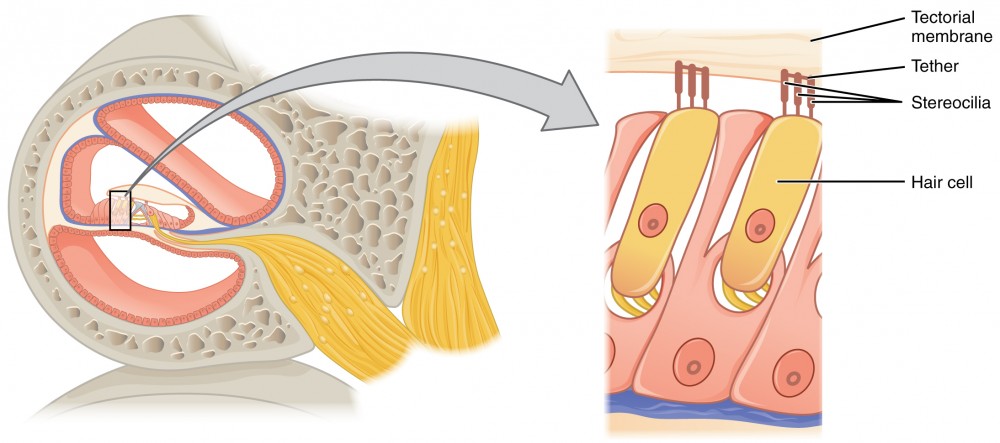
Each stereocilium tapers to a narrow ankle region where it joins the cuticular plate, a a central group of stereocilia actin filaments extends into the cuticular plate, forming a rootlet that anchors that stereocilium (Goodyear et al. 2006). The ankle region is more flexible than the more distal regions of the stereocilium and thus forms a hinge about which the stereocilium can be deflected toward or away from the kinocilium (or toward/away from the basal body that remains where there was once a kinocilium). Lateral deflections of the hair bundle (i.e., orthogonal to the short-long axis) are also possible, at least experimentally, but such deflections do not generate a receptor potential (Fettiplace and Kim 2014). It is because of their hairy appearance at the microscopic level that scientists call them hair cells. The function of the cells is to sense noise, which are actually disturbances of the air called sound waves. When sound passes into the ear, the hairy cells wiggle in response to the air movement, and pass on electric signals from their movement to nerves that transmit the sound onto the brain to interpret.

The Kinocilia of Cochlear Hair Cells: Structures, Functions, and Diseases
Gentamicin administration leads to synaptic dysfunction in inner hair cells - ScienceDirect.com
Gentamicin administration leads to synaptic dysfunction in inner hair cells.
Posted: Wed, 13 Dec 2023 20:33:02 GMT [source]
Other molecular components of the release machinery are only partially shared with those of central synapses. Synaptotagmin, the canonical Ca2+ sensor present in synaptic vesicles, does not intervene in exocytosis at hair cells (Safieddine and Wenthold, 1999). Instead, another candidate called otoferlin, with various Ca2+ binding domains, has been identified in a genetic screening in hearing impaired patients (Roux et al., 2006). Otoferlin presents high affinity for Ca2+ and also binds to the SNARE (N-ethylmaleimide sensitive factor attachment protein receptor) complex in a Ca2+ dependent manner, two fundamental properties required for a Ca2+ sensor candidate. Transgenic mice with a null otoferlin mutation show strongly impaired hearing and non-functional afferent synapses, albeit structurally normal (Roux et al., 2006; Pangršič et al., 2010).
Among them, the auditory system is mediated through ion channels and receptors present on the actin filament-based microvilli called stereocilia, in line with the tactile and taste systems. Mammalian kinocilia mediate HC morphogenesis and PCP, and the latter dictates the proper arrangement of stereocilia that is required for hearing. In mouse cochlear HCs, kinocilium development is complete around embryonic day 15 (E15), after which time they move to the non-neural side of the cell with the basal body. Meanwhile, nearby stereocilia gradually grow to form the three rows of stair-like and V-shaped stereocilia of different heights around E17, together forming the hair bundle (Williams et al., 2017).
If your scalp is frequently dry and itchy, you might wonder if a scalp detox might help. Scalp detoxing treatments come in different forms, but most aim to nourish your scalp and remove buildup, including from hair care products, debris, and dead skin cells. They reside in the ear, converting sound vibrations into electrical messages. Characteristics of the sound wave, such as frequency, are encoded in the pattern of hair cell activation and, consequently, auditory nerve cell activation. A scalp detox is a process of deep cleaning the scalp to remove product buildup, dead skin cells, oil, and dirt. These factors can lead to an itchy or dry scalp, dandruff, or scalp odor.
This is similar to the the organization of the mammalian cochlea, and raises the question of whether the basilar papilla membrane itself has mechanical resonance properties like the basilar membrane in the mammalian organ of Corti (Ricci et al. 2000). If that were the case, the electrical resonance of the hair cells could be viewed as increasing the ear’s existing sensitivity to specific tones, effectively acting as a gain amplifier. The question was explored in the turtle ear by laser interferometry, the result that the turtle basilar membrane appears to be broadly tuned and does not display intrinsic tonotopic resonance differences (O’Neill and Bearden 1995). Similar results have been reported from the chick cochlea (Xia et al. 2016).
The saccular epithelium orientation is approximately parasagittal (vertical to the ground), making it most sensitive to accelerations forward, backward, upward, or downward. The otoconial membrane also induces stereociliar bending if the epithelium is displaced by tilting, and in this way hair cells of the utricle and saccule can sense postural changes of head position by the effect of gravity (Goldberg et al. 2012). Sensory hair cells are highly specialized mechanosensitive cells found in all vertebrate animals in some related chordates (tunicates). The structure of hair cells makes them highly sensitive to displacement of the fluid environment that surrounds their apical microvilli, or stereocilia. The stereocilia are linked together and usually referred to as a hair bundle or hair cell bundle. By developing arrays of hair cells in their integument, animals can be highly sensitive to pressure waves or movement in the fluid environment surrounding the animal.
Recombinant receptors assembled from these subunits present a mixed nicotinic-muscarinic pharmacology (Elgoyhen et al., 1994, 2001; Rothlin et al., 1999; Verbitsky et al., 2000), similar to responses found years before in multiple end-organ preparations (Fuchs, 1996). The α9α10 receptor is a cationic channel with high Ca2+ permeability (Weisstaub et al., 2002; Gomez-Casati et al., 2005). In hair cells Ca2+ influx leads to the activation of a Ca2+-dependent small potassium conductance, SK2, producing cellular hyperpolarization (Fig. 3B, see also inset for detail of the currents) (Fuchs, 1996). The coupling of α9α10 and SK2 underlies the biphasic shape of efferent synaptic currents, as can be observed in Fig. 3B (Fuchs and Murrow, 1992; Martin and Fuchs, 1992; Blanchet et al., 1996; Glowatzki and Fuchs, 2000).
Two types of hair cells responsible for mechano-electrical transduction and auditory sensing are present in the cochlea. The stair-like W or V-shaped hair bundle appears on the apical plasma membrane of each inner hair cell and outer hair cell, collectively. Each hair bundle contains plenty of stereocilia and a kinocilium near the corner of them, and the kinocilium degenerates after maturation of hair cells, indicating the acquisition of hearing. Temporary and/or permanent auditory threshold shifts can occur in response to exposure to overly loud sounds.
The basilar papilla in chickens, like the cochlea in mammals, has hair cells arranged along the length of a basilar membrane according to frequency. Each sell has hair like stereocilia on top, arranged from shortest to tallest and attached to each other through thin tip links. Sound waves vibrate the basilar membrane beneath the hair cells, causing the cilia to move from side to side.


Comments
Post a Comment